.png)


Homigot, Pohang — Standing at the Edge of Korea

There are places that feel designed for photographs.
And then there are places that feel designed for reflection.
Homigot, on the eastern edge of South Korea, feels like the latter.
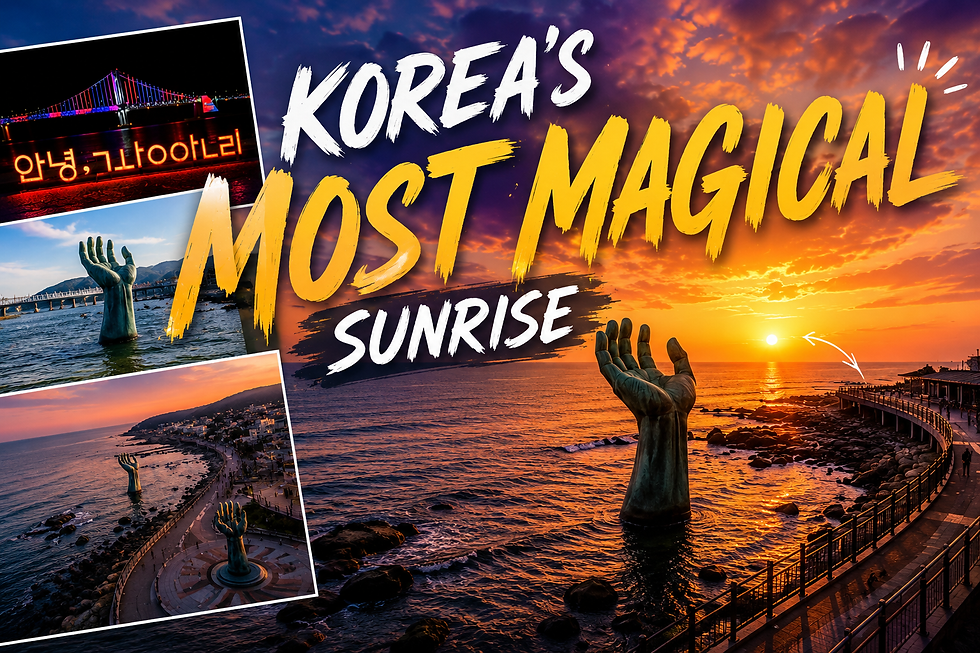
The name itself means “Cape of the Tiger,” because if you look at the Korean peninsula on a map, many Koreans say it resembles a tiger crouched in motion. Homigot forms part of that tiger’s tail — a place long associated with beginnings, endings, and the quiet symbolism of facing the sea.
People come here for sunrise.
For me, it felt more like arriving at the edge of something internal.
The wind was stronger than I expected when I stepped onto the coastline. Salt air moved heavily through the open space as waves crashed against the volcanic rock formations below. There’s a kind of rawness to Homigot that feels different from the polished energy of Seoul or even the cinematic beaches around Busan. This place feels exposed. Honest. Unprotected from the elements.
Maybe that’s why it stayed with me.

The most recognizable landmark here is the famous Hand of Harmony — one giant bronze hand rising from the sea while another mirrors it on land. Built in 1999 to welcome the new millennium, the sculpture symbolizes people reaching toward harmony and coexistence. Tourists gather around it constantly during sunrise, cameras raised, waiting for the moment the sun appears directly between the fingers.
But standing there in person, the sculpture feels less symbolic and more strangely human.
Almost like a reminder that we are always reaching for something:clarity, healing, purpose, connection, another version of ourselves.
And sometimes we don’t even realize it until we stop moving long enough to notice.
Pohang itself often gets overshadowed by Korea’s larger cities, yet historically it played an important role in the country’s modernization. Once primarily a fishing region, the city eventually became one of South Korea’s industrial powerhouses through POSCO, the steel company that helped fuel the nation’s rapid economic rise after the devastation of war and poverty in the mid-20th century.
That contrast is something I continue noticing throughout Korea.
This extraordinary tension between resilience and pressure. Between beauty and exhaustion. Between ancient philosophy and modern hyper-performance.

South Korea can feel incredibly futuristic and emotionally heavy at the same time.
And maybe that’s part of why I keep feeling drawn back here.
At Homigot, though, the noise softens.
The ocean has a way of reducing life back to its essentials. Standing there, watching the horizon stretch endlessly eastward toward Japan, I realized how rare it is to truly allow ourselves to pause without immediately trying to fill the silence again.
No music. No scrolling. No urgency.
Just wind.Water.Breath.
That has become one of the biggest lessons of my time in Korea:stillness is not emptiness.
It is information.
The older I get, the more I realize that clarity rarely arrives while we are rushing. It comes quietly, almost cautiously, after enough space has been created for it to enter.
And maybe that’s why walking has become such a central part of my travels and eventually the foundation for what would become The Solo Ways.
Not because walking magically solves everything.
But because movement strips away noise.
At Homigot, every gust of wind, every crashing wave, every step along the coastline seemed to ask the same question:
What are you still carrying that no longer belongs to you?
I don’t think travel changes us as much as people claim.
I think it reveals us.
And sometimes, standing at the far eastern edge of Korea with the ocean unfolding endlessly in front of you, revelation feels impossible to ignore.
The sun eventually began to lower, casting soft gold across the water and the giant bronze hand rising from the sea.
Tourists slowly disappeared.
The wind remained.
And for a little while longer, so did I.

WATCH THE FULL VLOG HERE:


Comments