.png)


Daegu: What Happens When You Stay a Little Longer

Some cities introduce themselves immediately.
They arrive through a recognizable skyline, a celebrated monument or a list of places everyone insists you must see. Others reveal themselves more gradually. Their meaning waits inside ordinary rooms, inherited knowledge and encounters that could never have been scheduled.
Daegu belonged to the second kind.
During the first part of my journey, I experienced the city through movement: the nighttime energy of Dongseong-ro, the slopes of Apsan, the seasonal beauty of Geumho Flower Island and the view from 83 Tower.
Staying longer allowed another Daegu to emerge.
This was a city of memory and medicine, quiet lakeside walks and spontaneous generosity. It was also where a drink with strangers became a night of music—and where the distance between visitor and belonging briefly disappeared.
Romance Papa: preserving the texture of ordinary life
My journey continued at Romance Papa, a retro hanok café near Seomun Market.
From the outside, it feels like a private family home discovered behind the changing city. Inside, wooden doors divide the rooms, mother-of-pearl furniture catches the light and objects from earlier decades occupy corners without becoming lifeless museum pieces.
Old radios, record players, cabinets, chairs, sewing machines and cups recall the rooms in which people once ate, repaired clothing, listened to music and gathered at the end of the day.
Grand history usually preserves rulers, wars and official dates. Places like Romance Papa preserve something more intimate: the texture of being alive between those events.
The café has been renovated for contemporary use, but it has not been stripped of its domestic character. Coffee and dessert are served inside rooms that still seem to remember the families who once lived in spaces like them.
Romance Papa does not attempt to freeze the past. It allows the old rooms to continue participating in the present.
That felt like an appropriate threshold for what came next.
Yangnyeongsi: the city that learned to heal
Leaving Romance Papa, I entered a district where history announces itself through scent.
The windows of Yakjeon Alley were filled with roots, bark, seeds, fungi and medicinal ingredients I could not identify. Everything had been dried, sorted and stored according to knowledge accumulated across generations.
Daegu Yangnyeongsi began in 1658, during the reign of King Hyojong. Originally held during limited periods in spring and autumn, it grew into one of Korea’s three major traditional herbal medicine markets.
Its reach eventually extended far beyond Daegu. Medicinal materials were distributed throughout Korea and traded with merchants connected to Japan, China, Russia and Europe.
The Daegu Yangnyeongsi Museum of Oriental Medicine now preserves this history through reconstructed shops, preparation tools, historical objects and displays of medicinal materials.
What fascinated me most was the philosophy behind them.
Traditional Korean medicine considers the person’s constitution, habits and larger pattern—not only the location of a symptom. Observation may include the face and tongue, voice and breathing, sleep, digestion, emotional state and pulse.
Two people can describe similar discomfort and still require different care.
The patient is understood as a relationship between systems rather than a collection of isolated parts.
Modern medicine gives us extraordinary ways of examining the body in detail. Yangnyeongsi introduced me to another valuable question: what might we discover by paying greater attention to the relationships between those details?
Dressing in history
The museum also gave me an opportunity to enter that history more playfully.
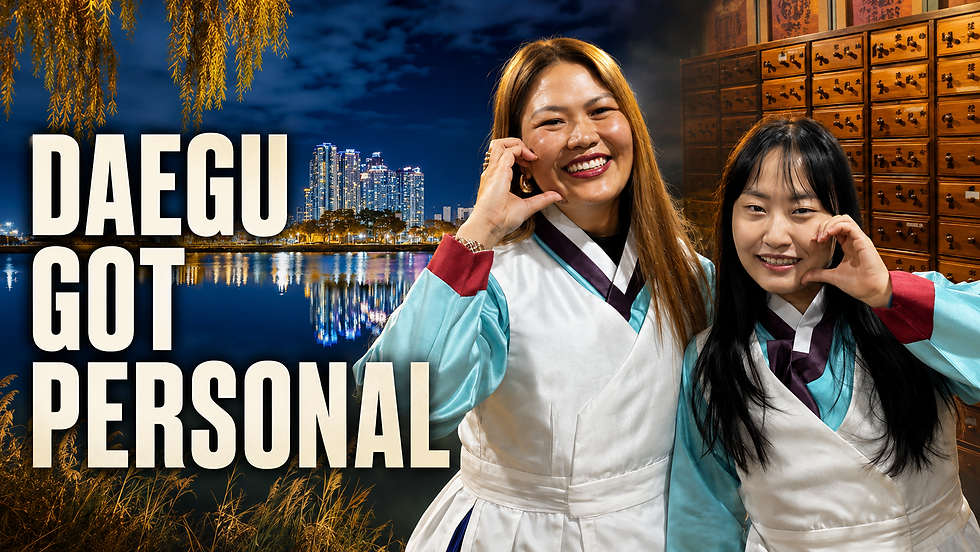
A young volunteer from Daegu University helped me dress first in a traditional hanbok and then in clothing representing a historical female medical practitioner.
Women who practiced medicine during the Joseon period occupied an important position. Strict social conventions could make it difficult for female patients to be examined by male physicians. Female practitioners therefore helped create a pathway through which women could receive medical attention while remaining within the boundaries imposed by the society around them.
The experience could easily have remained a formal costume demonstration.
Instead, the volunteer and I began posing, role-playing and laughing our way through it. For a little while, history stopped being something displayed behind glass. It became something we could enter and enjoy together.
Her warmth transformed the museum.
I had arrived expecting to learn about medicinal markets and traditional theories of the body. I left remembering the person who had helped bring those subjects to life.
That encounter alone made the museum worth visiting.
Britain Henge and an evening beside Suseong Lake
After spending most of the day surrounded by medicinal roots and historical exhibits, I crossed Daegu toward Suseong Lake.
Before beginning my walk, I stopped for coffee at Britain Henge, a bakery café inspired by an imagined corner of the British countryside. Its brick, dark wood and antique-style furnishings offered a curious change of atmosphere.
After hours of constitutional theories and centuries of medical history, coffee felt like a wonderfully uncomplicated prescription.
Then I stepped outside.
Suseong Lake appears to be one of Daegu’s natural retreats, but it is an artificial lake created in 1925 during the Japanese colonial period. Its original purpose was practical: supplying water to the agricultural land that once surrounded this part of the city.
A century later, the reservoir has been transformed into one of Daegu’s most popular gathering places.
The route around the water measures just over two kilometers. People come to walk, meet friends, visit lakeside cafés, listen to buskers and ride the cheerful duck boats drifting across the water.
Its musical fountain stretches approximately 90 meters and can send water as high as 70 meters into the air. The lake also appeared in the Korean television drama Hyde, Jekyll, Me.
By night, the buildings surrounding the lake shimmer in its surface. Couples walk beneath the trees, conversations drift between cafés and the city seems to soften around the water.
A reservoir built for agricultural survival has become a place for leisure, performance, dates and slow evening walks.
Its purpose changed.
The water remained.
Kim Gwang-seok Street and the night I never planned
Later, I reached the neighborhood surrounding Kim Gwang-seok Street.
The approximately 350-meter mural street was created near Bangcheon Market in memory of Korean singer-songwriter Kim Gwang-seok. Portraits, sculptures and references to his music now line the walls of the neighborhood where he once lived.
I did not have enough time to explore it properly before night settled over Daegu.
Near the street, I entered Bar Sun intending to have a quiet drink.
The evening had other plans.
I met the owners, their friends and people who gradually made room for me inside their gathering. Someone handed me a microphone. Familiar songs began playing. The careful distance that often exists between traveler and local disappeared into laughter, imperfect conversation and a room full of voices.
I stayed until two in the morning.
Nothing about the night had been arranged for the camera. There was no reservation, performance schedule or planned cultural encounter. It was simply one of those rare travel experiences in which strangers decide, for reasons you may never completely understand, to include you.
The landmarks had introduced me to Daegu.
That night, its people made the city unforgettable.
The morning after: Calorie Bar
The following day began with the physical consequences of the night before.
Fortunately, Daegu had one more wellness experience waiting for me.
As part of a collaboration, I visited Calorie Bar for a thermal body-care session. The treatment uses controlled heat as part of a wider approach to relaxation, perspiration and body management.
The warmth became progressively more intense, creating an experience somewhere between rest and endurance. After a night spent singing and drinking until two in the morning, lying still inside the treatment equipment felt strangely appropriate.
Calorie Bar should not be treated as a substitute for regular movement, balanced nutrition or medical care. Any meaningful or lasting change in health still depends upon the wider habits that surround a treatment.
What it offered me that morning was simpler: warmth, stillness and time to recover before continuing my journey.
The experience featured in the film was provided as part of a collaboration. My observations remain my own, and individual experiences may vary.
Modac Texas BBQ and one last gathering
My final Daegu meal brought the story back to the people I had met the previous night.
At Modac Texas BBQ near Dongdaegu Station, the journey closed over brisket, shared dishes and conversation. After spending so much of the trip moving independently from one destination to another, it felt meaningful to leave Daegu at a table with familiar faces.
Travel connections do not always need years to become real.
Sometimes a few hours are enough to change the emotional shape of a city. A person who was a stranger yesterday becomes part of the story you will tell about a place for years.
From Modac, I continued toward the station, the airport and eventually Jeju.
Daegu was now behind me.
The experience of it was not.
What happens when you stay a little longer?
Staying longer does not guarantee revelation.
It simply creates room for it.
The first impression of a city is often formed by what has been built for us to see. A deeper impression emerges through repetition, chance and attention: returning to the street after dark, entering a place without knowing what will happen, or allowing a conversation to outlast the original plan.
Daegu gradually shifted from destination to relationship.
Romance Papa preserved the memory of domestic life. Yangnyeongsi carried forward centuries of knowledge about healing. Suseong Lake showed how a place created for survival could be reimagined for pleasure. Kim Gwang-seok Street kept a musician present through images and songs.
The people I met added something no monument could provide.
They allowed me to participate.
That is what I carried with me when the airplane left for Jeju: the understanding that attention changes experience, but time creates the conditions in which attention can deepen.
Some cities impress us immediately.
Others wait to see whether we will stay.
Watch the film
DAEGU: What Happens When You Stay a Little Longer
You can begin with the first Daegu film here:
DAEGU: From Neon Streets to Mountain Views
Places featured
Always confirm current opening hours, admission policies and reservation requirements directly with each venue before visiting Daegu.


Comments